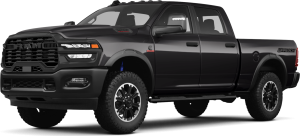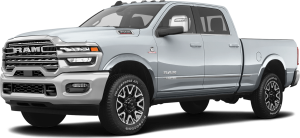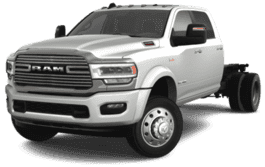
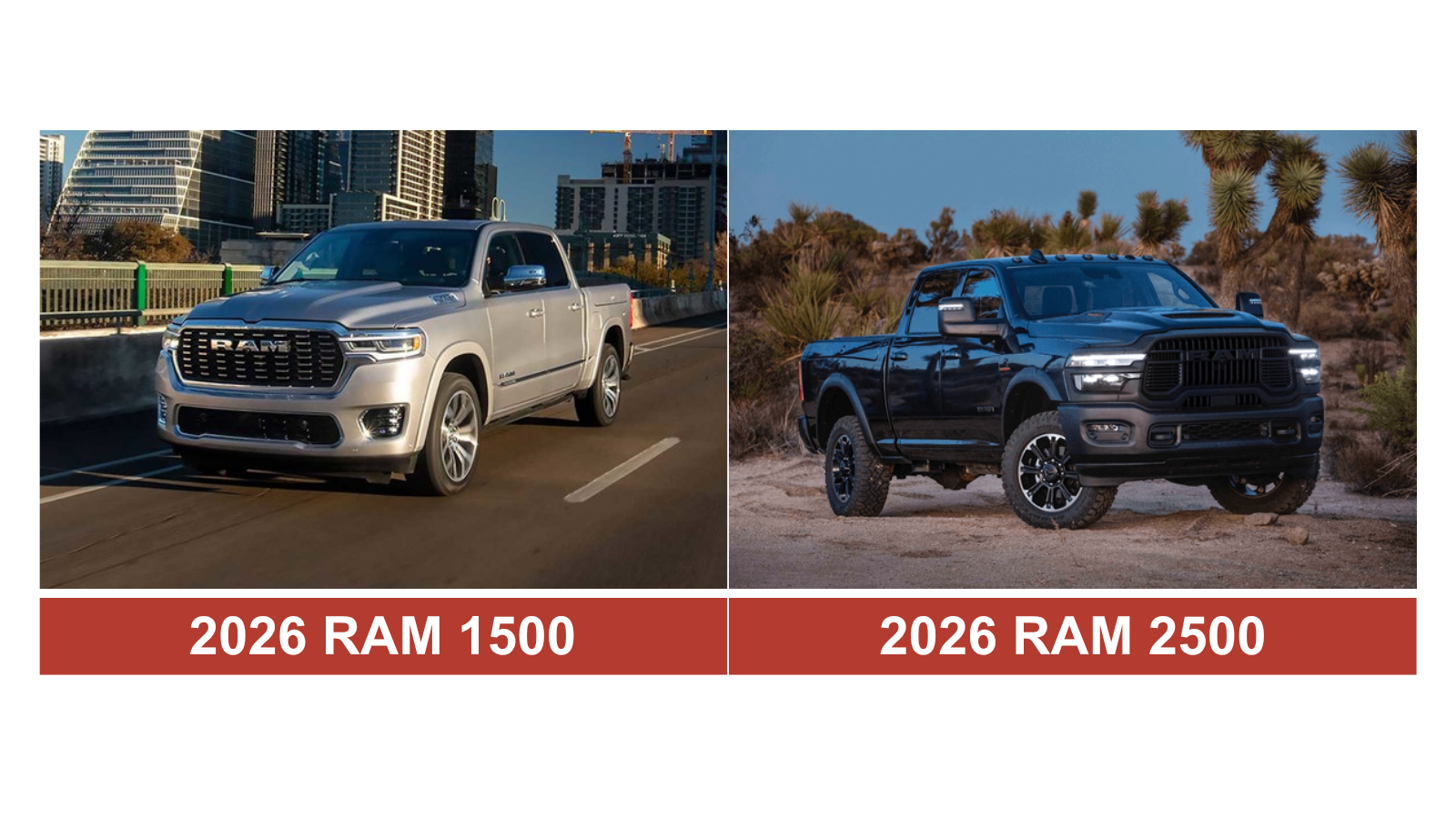
The Ram 1500 is the right truck for the majority of Alberta drivers — it tows up to 5,783 kg (12,750 lbs), hauls up to 1,054 kg (2,325 lbs) of payload, and delivers significantly better fuel economy with your choice of three powertrains including the 3.0L Hurricane Twin-Turbo I6. If your needs consistently exceed those numbers — a large fifth-wheel RV, a heavy horse trailer, construction equipment, or oil-field loads — the Ram 2500 is purpose-built for the job, with max towing up to 11,793 kg (26,000 lbs) when equipped with the 6.7L Cummins Turbo Diesel. The question isn't which truck is better. It's which truck matches what you actually haul.
Key Takeaways
- The Ram 1500 is a light-duty half-ton rated for up to 5,783 kg (12,750 lbs) towing and up to 1,054 kg (2,325 lbs) payload — well matched for the majority of personal and light commercial use in Central Alberta.
- The Ram 2500 is a heavy-duty three-quarter-ton rated for up to approximately 11,793 kg (26,000 lbs) towing (5th wheel/gooseneck with diesel) and up to 1,724 kg (3,800 lbs) payload — built for commercial work, large RVs, and heavy agricultural use.
- The Ram 1500's available 3.0L Hurricane Twin-Turbo I6 (420 hp) is estimated at around 9.5 L/100 km combined — considerably more efficient than the Ram 2500's 6.4L HEMI V8 (est. ~14.0 L/100 km) or 6.7L Cummins Turbo Diesel (est. ~11.1 L/100 km).
- The Ram 1500 uses an independent rear coil spring suspension unique in its class — delivering a noticeably more car-like daily ride than the Ram 2500's solid rear axle and leaf spring setup.
- The Ram 2500's available 6.7L Cummins Turbo Diesel produces 1,152 Nm (850 lb-ft) of torque — the highest torque output of any truck engine in its class available in Canada.
- The Ram 2500's Power Wagon trim adds a factory-fitted winch, electronic front sway bar disconnect, and locking differentials front and rear — off-road capability that requires extensive aftermarket work to replicate on any other platform.
- 2026 Ram 1500 pricing starts at approximately $44,895 CAD (Tradesman); Ram 2500 pricing starts higher — contact Red Deer Dodge at 403-346-2035 for current pricing, available Ram Canada incentives, and in-stock units.
- Red Deer Dodge carries both Ram 1500 and Ram 2500 lineups and serves drivers across Central Alberta including Sylvan Lake, Lacombe, Ponoka, Innisfail, and Rocky Mountain House.
For most Alberta drivers, the choice between a 2026 Ram 1500 and a 2026 Ram 2500 comes down to one honest question: how much are you actually towing, and how often? Both are exceptional trucks built on the same platform heritage. Both offer the same legendary Ram interior quality, advanced safety technology, and the kind of build quality that holds up through Alberta winters, gravel roads, and decades of hard use. But they are engineered for fundamentally different jobs — and choosing the wrong one costs you either capability you needed or efficiency and comfort you're paying for every day.
The Ram 1500 is a purpose-built half-ton that outclasses its competitors in ride quality, technology, and powertrain efficiency. The Ram 2500 is a purpose-built heavy-duty truck that prioritizes raw towing and payload capability above all else. Knowing which side of that line your needs fall on is the only thing standing between a truck purchase you'll be happy with for ten years and one you'll want to trade in by year three.
Ram 1500 vs Ram 2500: What's the Real Difference?
The most important distinction between a Ram 1500 and a Ram 2500 isn't the badge on the tailgate — it's the GVWR (Gross Vehicle Weight Rating), which defines the maximum total weight the truck is engineered to safely handle, including the vehicle itself, passengers, cargo, and any tongue weight from a trailer.
The Ram 1500 is classified as a half-ton light-duty truck with a GVWR typically under 4,082 kg (9,000 lbs). The Ram 2500 is a three-quarter-ton heavy-duty truck with a GVWR typically between 4,082–5,443 kg (9,001–12,000 lbs). That difference flows through to every major component: the frame, the axles, the brakes, the suspension, the cooling system, and the available engine options. A heavier-rated GVWR isn't just a number on paper — it reflects the engineering and materials used throughout the entire truck.
For Alberta drivers, this matters practically. If you're towing a standard dual-axle horse trailer loaded with two horses — approximately 2,500–3,200 kg — a properly configured Ram 1500 handles that load within its rated capacity with margin to spare. If you're running a gooseneck trailer hauling equipment to a job site near Drayton Valley, or pulling a large fifth-wheel RV north to Grande Prairie every summer, those loads push into territory where the Ram 2500's heavier-duty engineering pays for itself over the life of the truck.
Half-Ton vs Three-Quarter-Ton: What the Designations Mean
The terms "half-ton" and "three-quarter-ton" are legacy designations that no longer reflect the actual payload capacities of modern trucks — but they persist because they accurately describe the relative positioning of these trucks within the lineup. A half-ton like the Ram 1500 is the lighter-duty option optimized for versatility and comfort. A three-quarter-ton like the Ram 2500 is the heavy-duty workhorse optimized for load and tow capacity. Between the two sits a fundamental engineering trade-off: the heavier-duty components that give the Ram 2500 its capability also add weight, reduce fuel economy, and stiffen the ride compared to the Ram 1500.
2026 Ram 1500: Engine Options and Performance Specs
The 2026 Ram 1500 offers three engine options — more variety than any other full-size truck in Canada — allowing buyers to match their powertrain to their specific use case rather than accepting a one-size-fits-all approach.
Ram 1500 Engine Lineup
| Engine | Power | Torque | Transmission | Est. Fuel Economy (Combined) |
|---|---|---|---|---|
| 3.6L Pentastar V6 eTorque | 305 hp | 365 Nm (269 lb-ft) | 8-speed automatic | ~11.6 L/100 km |
| 5.7L HEMI V8 eTorque | 395 hp | 556 Nm (410 lb-ft) | 8-speed automatic | ~12.4 L/100 km |
| 3.0L Hurricane Twin-Turbo I6 (Standard Output) | 420 hp | 636 Nm (469 lb-ft) | 8-speed automatic | ~9.5 L/100 km |
| 3.0L Hurricane Twin-Turbo I6 (High Output) | 500 hp | 712 Nm (525 lb-ft) | 8-speed automatic | ~9.8 L/100 km |
The standout choice for most buyers is the Hurricane I6. It produces more horsepower than the HEMI V8 while consuming significantly less fuel — the result of twin turbochargers, direct injection, and cylinder deactivation working together. In Alberta's mix of city commuting and long highway stretches on the QE2, the Hurricane's efficiency advantage compounds into real savings over three to five years of ownership.
Ram 1500 Capability Specs
| Specification | 2026 Ram 1500 |
|---|---|
| Max Towing Capacity | Up to 5,783 kg (12,750 lbs) |
| Max Payload Capacity | Up to 1,054 kg (2,325 lbs) |
| Rear Suspension | Independent coil spring (class-exclusive) |
| 4x4 System | Part-time (electronic shift-on-the-fly) |
| Box Lengths | Standard (1,676 mm), Long (1,981 mm), Multifunction (1,829 mm) |
| Cab Configurations | Regular, Quad, Crew |
| Cargo Box Volume (Multifunction) | Up to 1,615 L |
2026 Ram 2500: Engine Options and Performance Specs
The Ram 2500 is offered with two engines — a high-displacement gas V8 or the legendary Cummins Turbo Diesel. Choosing between them is effectively choosing between different use cases.
Ram 2500 Engine Lineup
| Engine | Power | Torque | Transmission | Est. Fuel Economy (Combined) |
|---|---|---|---|---|
| 6.4L HEMI V8 (gas) | 410 hp | 582 Nm (429 lb-ft) | 8-speed automatic | ~14.0 L/100 km |
| 6.7L Cummins Turbo Diesel I6 | 370 hp | 1,152 Nm (850 lb-ft) | 6-speed automatic | ~11.1 L/100 km |
The 6.7L Cummins produces 1,152 Nm (850 lb-ft) of torque — a figure that has no rival among truck engines sold in Canada. That torque is available at low RPM, which is exactly where towing and hauling demands it: getting a heavy trailer moving from a dead stop, maintaining speed on a long uphill grade on Highway 93, or controlling a loaded gooseneck on a steep descent. Diesel fuel prices in Alberta have historically tracked closely with gasoline, so the efficiency advantage of the Cummins over the 6.4L HEMI V8 is a meaningful factor in long-term operating cost — particularly for high-mileage commercial users.
The 6.4L HEMI V8 is the right choice for buyers who do a mix of work and light recreation, prefer gasoline, or don't require the Cummins' maximum towing numbers. It delivers all the power most Ram 2500 applications require at a lower upfront cost than the diesel option.
Ram 2500 Capability Specs
| Specification | Ram 2500 — 6.4L HEMI V8 | Ram 2500 — 6.7L Cummins Diesel |
|---|---|---|
| Max Conventional Towing | Up to approx. 7,711 kg (17,000 lbs) | Up to approx. 8,165 kg (18,000 lbs) |
| Max 5th Wheel / Gooseneck Towing | Up to approx. 9,979 kg (22,000 lbs) | Up to approx. 11,793 kg (26,000 lbs) |
| Max Payload | Up to 1,588 kg (3,500 lbs) | Up to 1,724 kg (3,800 lbs) |
| Rear Suspension | Solid rear axle, leaf spring | Solid rear axle, leaf spring |
| 4x4 System | Part-time with auto-engage available | Part-time with auto-engage available |
Towing and payload figures are maximum rated values and vary by cab, box, and equipment configuration. Consult your window sticker or contact Red Deer Dodge for figures specific to the unit you're considering.
Towing Capacity: Ram 1500 vs Ram 2500 for Alberta Use
Towing capacity is the most decisive specification for most truck buyers in Central Alberta — and the gap between a Ram 1500 and Ram 2500 is significant enough to be the single deciding factor in most comparisons.
| Vehicle | Max Conventional Towing | Max 5th Wheel / Gooseneck | Best For |
|---|---|---|---|
| 2026 Ram 1500 (Hurricane I6) | Up to 5,783 kg (12,750 lbs) | N/A | Boats, ATVs, light travel trailers, horse trailers (2 horse) |
| 2026 Ram 2500 (6.4L HEMI) | Up to 7,711 kg (17,000 lbs) | Up to 9,979 kg (22,000 lbs) | Large travel trailers, heavy equipment, livestock trailers |
| 2026 Ram 2500 (6.7L Cummins) | Up to 8,165 kg (18,000 lbs) | Up to 11,793 kg (26,000 lbs) | Large fifth-wheel RVs, heavy gooseneck trailers, oil-field equipment |
Towing Scenarios: Where Each Truck Fits Alberta Life
Understanding which truck fits your towing needs is easier with real-world weight references that match Central Alberta use cases.
A dual-axle bumper-pull horse trailer loaded with two horses typically weighs 2,700–3,600 kg. A Ram 1500 handles this well within its rated capacity with significant margin. A three-horse slant-load trailer with tack loaded in is frequently 4,500–5,500 kg — still within Ram 1500 territory when loaded moderately, but approaching the limit on a heavily loaded day. A six-horse trailer or a large stock trailer is where the Ram 2500 becomes the appropriate choice.
A fifth-wheel RV in the 9,000–11,000 kg range — the type increasingly popular with Alberta retirees heading south for winters — requires a Ram 2500 Cummins. A Ram 1500 is simply not rated for that load. Running a truck consistently near or above its rated capacity accelerates brake wear, transmission heat cycling, and chassis fatigue in ways that aren't always visible until the repair bill arrives.
For contractors in the Drayton Valley, Rocky Mountain House, or Stettler areas running equipment trailers with a skid steer or mini excavator — equipment that commonly weighs 3,000–5,500 kg — a Ram 1500 covers lighter equipment. Anything heavier, and the Ram 2500 is the professionally appropriate tool.
Payload: How Much Can Each Truck Actually Haul in the Box?
Payload capacity — the weight of cargo, passengers, and accessories the truck can carry in the box and cab — is frequently misunderstood and equally frequently exceeded by buyers who didn't check it before loading up.
The Ram 1500's max payload of 1,054 kg (2,325 lbs) sounds substantial until you account for what goes into the cab. Four adult passengers, a full fuel tank, and a few hundred kilograms of gear in the box can move a Ram 1500 close to its payload limit before the first bag of gravel goes in. Buyers who regularly haul heavy material — gravel, topsoil, hay bales, commercial goods, tools — should calculate their real-world payload needs honestly before choosing the 1500.
The Ram 2500's payload ceiling of up to 1,724 kg (3,800 lbs) with the Cummins gives working trucks real room to load up without concern. For landscapers, farmers hauling mineral supplements, contractors carrying compressors and power tools, or anyone who regularly fills a truck box with dense material, the difference between 1,054 and 1,724 kg isn't marginal — it's the difference between one trip and two.
Fuel Economy: Ram 1500 vs Ram 2500 in Alberta
Fuel efficiency is one of the most significant operational differences between the two trucks — and the gap compounds over years of Alberta driving.
| Engine | Truck | Est. City | Est. Hwy | Est. Combined | Approx. Annual Fuel Cost* |
|---|---|---|---|---|---|
| 3.0L Hurricane I6 (SO) | Ram 1500 | ~11.4 L/100 km | ~8.0 L/100 km | ~9.5 L/100 km | ~$2,850 |
| 5.7L HEMI V8 eTorque | Ram 1500 | ~14.7 L/100 km | ~10.7 L/100 km | ~12.4 L/100 km | ~$3,720 |
| 6.7L Cummins Turbo Diesel | Ram 2500 | ~13.1 L/100 km | ~9.7 L/100 km | ~11.1 L/100 km | ~$3,330† |
| 6.4L HEMI V8 | Ram 2500 | ~16.8 L/100 km | ~12.0 L/100 km | ~14.0 L/100 km | ~$4,200 |
*Annual fuel cost estimates based on 20,000 km/year at approximately $1.50/L gasoline. †Diesel estimate uses similar per-litre pricing; actual diesel vs. gasoline price differential varies. Fuel economy figures are estimates for unloaded highway/mixed driving; towing or hauling adds significant fuel consumption for all powertrains.
The Ram 1500 Hurricane I6 saves approximately $870–$1,350 per year in fuel versus the Ram 2500 gas V8 at 20,000 km annually — a figure that grows with fuel prices and mileage. For a driver who covers 30,000 km per year on the QE2 corridor between Red Deer and Edmonton, the Hurricane I6's efficiency advantage over a Ram 2500 HEMI can represent $3,000–$5,000 in fuel savings over three years of ownership.
It's important to note that both trucks consume significantly more fuel when loaded or towing — any truck does. The gap between the Ram 1500 and Ram 2500 narrows when the Ram 1500 is running at or near its towing limit, as the engine works harder to maintain speed. The Ram 2500 Cummins' advantage at a heavy tow load is that it produces its massive torque at low RPM, requiring less throttle input and burning less fuel per kilometre than a gasoline engine working the same load.
Ride Quality and Daily Driving: A Meaningful Difference
If you drive to work Monday through Friday, drop kids at school, and park in a Red Deer mall parking lot four days out of five, ride quality matters more than maximum towing capacity.
The Ram 1500 uses a class-exclusive independent rear coil spring suspension — meaning each rear wheel moves independently on its own spring and shock absorber. The result is a ride quality that is genuinely car-like on Alberta's variable pavement: smooth over expansion joints, composed on broken asphalt, and noticeably quieter at highway speed than leaf-spring competitors. For daily drivers, this is a significant quality-of-life factor.
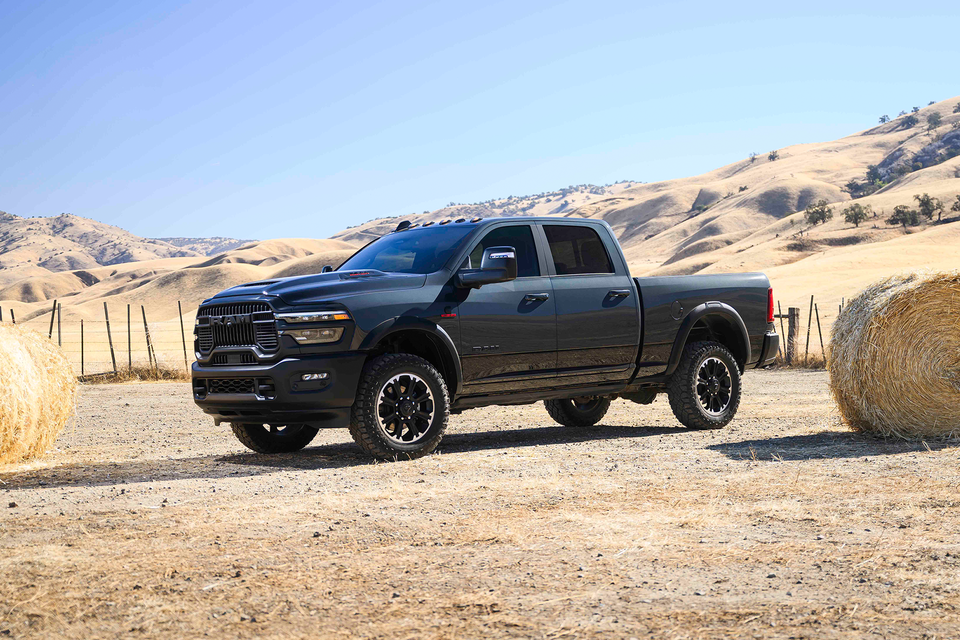
The Ram 2500 uses a solid rear axle with leaf springs — heavier components designed to carry the loads the 2500 is rated for. When the Ram 2500 is unloaded, which it will be for most of any truck owner's driving, the stiff leaf springs transmit more road vibration into the cab. The Ram 2500 is well-tuned for a heavy-duty truck, and Ram's active-level air suspension option improves things considerably — but it will never ride like a Ram 1500 without a load in the box. That's an engineering reality, not a design flaw. It's the inevitable trade-off of a truck built to carry 1,724 kg in the bed.
For buyers who use their truck five days a week as a commuter and one weekend a month for a camping trip, the Ram 1500's daily driving experience is the better fit. For buyers whose truck is a work tool used primarily loaded or towing — a landscaper, a farmer, a construction contractor — the Ram 2500's stiff empty ride is acceptable because it's rarely encountered.
Cab Interior and Technology
Both the Ram 1500 and Ram 2500 offer Ram's award-winning interior quality, available in configurations from the no-frills Tradesman work truck to the leather-wrapped luxury of the Limited and Longhorn trims. Both feature the Uconnect 5 system with available 12-inch and 12.3-inch touchscreens, wireless Apple CarPlay and Android Auto, a digital instrument cluster, and a comprehensive suite of driver assistance technology.
The Ram 1500's available RamBox® integrated cargo management system — built-in, locking, drainable storage compartments in the box rails — is not available on the Ram 2500. For buyers who use their truck box for gear storage as much as cargo hauling, the RamBox is a practical feature worth noting.
Ram 1500 vs Ram 2500 vs Competitors: How They Stack Up
| Feature | 2026 Ram 1500 | 2026 Ram 2500 (Diesel) | 2025 Ford F-150 | 2025 GMC Sierra 2500HD |
|---|---|---|---|---|
| Max Towing | 5,783 kg (12,750 lbs) | 11,793 kg (26,000 lbs) | 5,987 kg (13,200 lbs) | 9,979 kg (22,000 lbs) |
| Max Payload | 1,054 kg (2,325 lbs) | 1,724 kg (3,800 lbs) | 997 kg (2,200 lbs) | 1,656 kg (3,650 lbs) |
| Best Est. Fuel Economy (Combined) | ~9.5 L/100 km (Hurricane I6) | ~11.1 L/100 km (Cummins) | ~10.2 L/100 km (PowerBoost Hybrid) | ~13.1 L/100 km (Duramax Diesel) |
| Rear Suspension | Independent coil spring | Solid axle, leaf spring | Independent coil spring | Solid axle, leaf spring |
| Class | Light-duty (half-ton) | Heavy-duty (three-quarter-ton) | Light-duty (half-ton) | Heavy-duty (three-quarter-ton) |
2026 Ram 1500 vs Ram 2500: Which One Is Right for You?
The right truck is determined by your actual use — not your aspirational use. Here's a practical decision guide for Alberta buyers.
| Your Situation | Recommended Truck |
|---|---|
| Towing a boat, ATV trailer, or small camper (under 3,500 kg) | Ram 1500 |
| Towing a bumper-pull horse trailer with 2–3 horses | Ram 1500 |
| Daily commuter truck with occasional weekend towing | Ram 1500 |
| Light commercial use — deliveries, hauling tools, small loads | Ram 1500 |
| Towing a large travel trailer or fifth-wheel under 5,500 kg | Ram 1500 (with Hurricane I6 — check your specific trailer weight) |
| Towing a large fifth-wheel RV or livestock trailer over 5,500 kg | Ram 2500 |
| Towing heavy gooseneck — equipment, flatbed, large stock trailer | Ram 2500 |
| Commercial use — farm, construction, oil field, regular heavy hauling | Ram 2500 |
| Maximum off-road capability with factory winch and lockers | Ram 2500 Power Wagon |
| Highest towing capacity with maximum efficiency | Ram 2500 with 6.7L Cummins Turbo Diesel |
One honest note: many buyers overestimate how much they tow and underestimate how much they drive. If the Ram 2500 would be used at its rated capacity two or three times a year and commuted 25,000 km annually at otherwise, the Ram 1500 delivers a better total ownership experience — lower fuel cost, better ride, easier parking, and comparable capability for the uses that actually occur. The Ram 2500 is the right truck when your heaviest loads happen regularly, not occasionally.
2026 Ram 1500 and Ram 2500 Pricing in Canada
Both Ram 1500 and Ram 2500 are available in a range of trims from the bare-bones Tradesman to the fully loaded Limited and Longhorn. Engine choice, cab configuration, box length, and option packages all affect the final price.
| Trim | Ram 1500 Starting Price (CAD) | Ram 2500 Starting Price (CAD) |
|---|---|---|
| Tradesman | From approx. $44,895 | From approx. $62,995 |
| Big Horn | From approx. $52,195 | From approx. $72,295 |
| Rebel / Power Wagon | From approx. $61,295 (Rebel) | From approx. $82,000 (Power Wagon) |
| Laramie | From approx. $63,395 | From approx. $82,500 |
| Longhorn | From approx. $71,595 | From approx. $89,000 |
| Limited | From approx. $79,295 | From approx. $97,000 |
Prices are approximate MSRP in CAD and exclude taxes, freight, PDI, and dealer fees. Cummins Turbo Diesel adds approximately $10,000–$12,000 to Ram 2500 pricing depending on trim. Available Ram Canada incentives, fleet pricing, and in-stock vehicle pricing may differ. Contact Red Deer Dodge at 403-346-2035 for current pricing on specific units.
The Ram 2500 costs approximately $18,000–$20,000 more than a comparably equipped Ram 1500 before engine upgrades. Buyers who genuinely need the Ram 2500's capability will recover that investment through the jobs they can take, the trips they can complete without limitations, and the reduced wear and tear of operating a truck within — rather than at — its rated capacity. Buyers who don't need the extra capability are paying that premium for a stiffer ride and higher fuel bills.
Maintaining Your Ram 1500 or Ram 2500 in Alberta
Both trucks are built for Alberta conditions, but keeping either in peak working condition requires attention to the factors that make this province's environment particularly demanding: road salt from October through April, temperature extremes exceeding 70°C between summer and winter, and the particulate load from gravel roads and agricultural use.
For Ram 1500 owners, the Hurricane I6 is a sophisticated twin-turbocharged engine that benefits from consistent synthetic oil changes on the factory-recommended interval — especially given Alberta's temperature swings. The Ram 2500's Cummins Turbo Diesel requires diesel exhaust fluid (DEF) monitoring and fuel filter changes at manufacturer-specified intervals, both of which our service team at Red Deer Dodge handles routinely. For both trucks, annual brake fluid inspection is worthwhile given Alberta's temperature cycling, and transfer case fluid service every 50,000–60,000 km keeps the 4x4 system operating as intended when you need it on a January morning on an unplowed side road west of Lacombe.
FAQ
What is the main difference between a Ram 1500 and Ram 2500?
Is the Ram 1500 good enough for towing in Alberta?
Is the Ram 2500 Cummins diesel worth it in Canada?
How does the Ram 1500 Hurricane I6 compare to the 5.7L HEMI?
Does the Ram 1500 or Ram 2500 handle Alberta winters better?
What is the 2026 Ram 2500 towing capacity in Canada?
What is the price difference between a Ram 1500 and Ram 2500 in Canada?