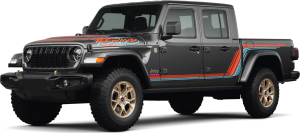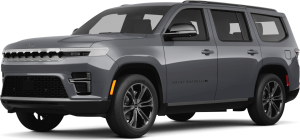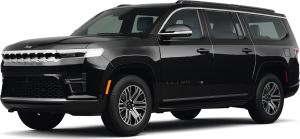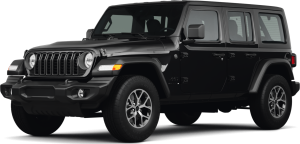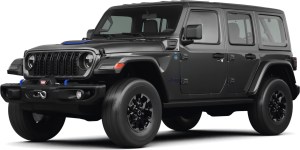
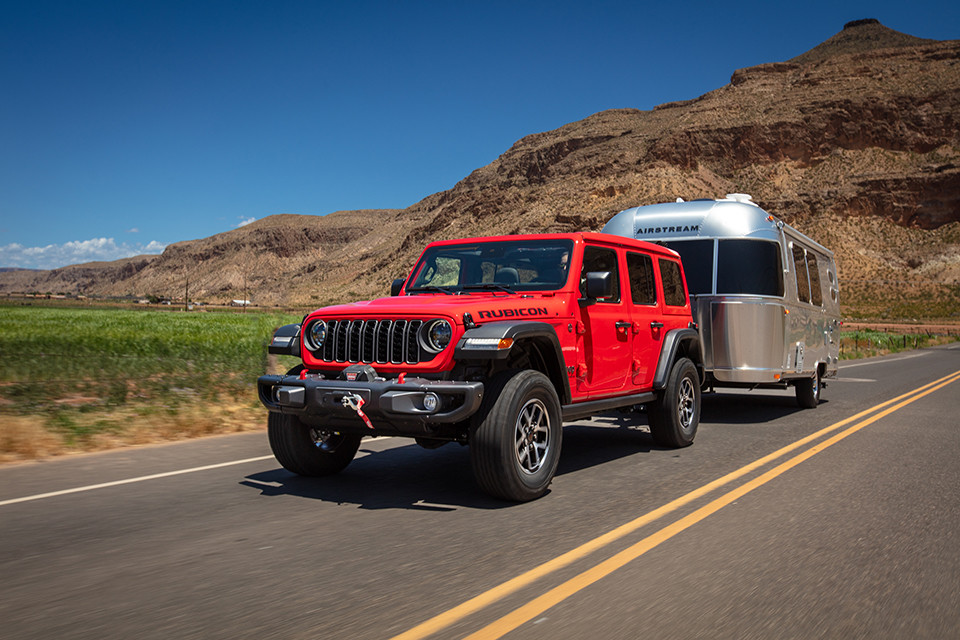
The 2026 Jeep Wrangler and 2026 Toyota 4Runner are both body-on-frame 4x4 SUVs built for drivers who go beyond paved roads — but they're optimized differently. The Wrangler leads on raw off-road geometry: the Rubicon delivers a 43.6° approach angle, 26.7 cm of ground clearance, 762 mm water fording depth, solid front and rear axles, and standard locking differentials. The 2026 4Runner counters with higher towing (up to 2,268 kg vs the Wrangler's 1,587 kg), significantly more cargo space (~2,540 L vs ~872 L seats-folded), and the i-FORCE MAX hybrid at approximately 9.4 L/100 km combined — well ahead of the Wrangler's 10.7–12.3 L/100 km range. For Alberta drivers who prioritize trail performance and Jeep's Trail Rated certification, the Wrangler is the benchmark. For families who need interior space and towing alongside trail capability, the 4Runner is the stronger daily driver. Red Deer Dodge carries the full 2026 Jeep Wrangler lineup in Red Deer, Alberta.
Key Takeaways
- Both the 2026 Jeep Wrangler and 2026 Toyota 4Runner use body-on-frame construction — a design that sets them apart from virtually every unibody crossover in their price range and gives both genuine durability on rough terrain.
- The Wrangler Rubicon 4-door leads in off-road geometry: 43.6° approach angle, 26.7 cm ground clearance, 762 mm water fording depth, solid axles front and rear, and standard locking differentials front and rear — capabilities the 4Runner TRD Pro cannot fully match.
- The 2026 Toyota 4Runner with the i-FORCE MAX hybrid produces 326 hp and approximately 9.4 L/100 km combined — significantly better than any Wrangler petrol engine, which ranges from 10.7 to 12.3 L/100 km depending on engine choice.
- The 4Runner tows up to 2,268 kg (5,000 lbs) and offers approximately 2,540 L of cargo volume with all seats folded — the Wrangler 4-door is rated to 1,587 kg (3,500 lbs) with approximately 872 L of cargo space.
- The Wrangler's Rock-Trac 4:1 low-range transfer case (Rubicon), Selec-Terrain system with Rock mode, and removable doors, roof, and windshield give it a trail versatility the 4Runner cannot replicate. The 4Runner's Crawl Control and KDSS (TRD Pro) offer strong trail support with more on-road refinement.
- The 2026 Jeep Wrangler starts from approximately $46,395 CAD; the 2026 Toyota 4Runner from approximately $49,990 CAD. Red Deer Dodge carries the Wrangler lineup and serves Central Alberta, including Sylvan Lake, Lacombe, Innisfail, and Rocky Mountain House.
Two of the most capable body-on-frame SUVs you can buy in Canada sit at the centre of one of the most common comparisons in Alberta dealerships: the 2026 Jeep Wrangler against the 2026 Toyota 4Runner. Both take off-road capability seriously, both sell in meaningful numbers across Central Alberta, and both are cross-shopped by buyers who want genuine 4x4 performance without giving up daily usability. The question is not which one is better in the abstract. It is which one is built for the driving you actually do — on Red Deer's grid roads in January, on gravel highways west of Highway 22, and on the trails in Kananaskis Country come summer.
The Wrangler has been Jeep's trail standard for decades. It runs solid front and rear axles, earns Trail Rated certification on every trim in the lineup, and is the only mainstream SUV still sold with removable doors, a fold-down windshield, and an optional soft or hard top you can take off entirely. The 2026 Toyota 4Runner enters its second year on a completely redesigned platform — still body-on-frame, now with an available 326 hp i-FORCE MAX turbocharged hybrid powertrain that dramatically improves the fuel consumption the previous generation's V6 could never address. Both vehicles have strong cases for Alberta drivers. Here's how they compare across the criteria that matter most.
What Sets the 2026 Wrangler and 4Runner Apart?
Both the Wrangler and the 4Runner use body-on-frame construction — a design that has largely disappeared from the midsize SUV market. A ladder frame flexes independently from the body, absorbing the twisting forces of uneven terrain without transmitting stress into the passenger compartment. It also means the drivetrain, suspension, and body can each be engineered to a higher tolerance without compromise. The Toyota RAV4, Ford Bronco Sport, and most competitors in this price range use a unibody platform optimized for pavement. When you're crossing a frost-heaved access road outside Lacombe or navigating a rutted trail west of Rocky Mountain House, ladder-frame durability matters.
Beyond that shared architecture, the two vehicles diverge sharply. The Wrangler is defined by its suspension design — solid front and rear axles that maximize articulation and keep all four wheels planted on terrain regardless of surface angle. The 4Runner uses a double-wishbone independent front suspension paired with a solid rear axle, delivering more on-road comfort while retaining reasonable off-road capability. The Wrangler accepts more punishment on technical trails. The 4Runner handles Alberta's long highway stretches more gracefully. That tradeoff shapes every other comparison in this article.
Trail Rated vs TRD Off-Road and TRD Pro: What the Badges Mean
Jeep's Trail Rated certification applies to every Wrangler in the lineup — not just the Rubicon. It requires passing controlled tests in five areas: traction, ground clearance (minimum 203 mm), manoeuvrability, articulation, and water fording (minimum 500 mm). Every Wrangler leaves the factory meeting those standards.
Toyota's TRD Off-Road and TRD Pro trims equip the 4Runner with Bilstein shocks, KDSS (Kinetic Dynamic Suspension System, standard on TRD Pro), Multi-Terrain Select, Crawl Control, and available rear locking differential. These are capable systems — but Toyota does not certify them against an equivalent independent standard, and the base SR5 trim carries significantly less off-road hardware than either TRD variant. Buyers who want guaranteed factory off-road capability at any price point in the lineup have a clearer path with the Wrangler.
Off-Road Capability Comparison
The numbers that define a vehicle's ability to handle terrain — approach angle, departure angle, breakover angle, ground clearance, water fording depth, and axle design — tell the core of this comparison. The Wrangler Rubicon's figures represent the top of the mainstream off-road SUV segment. The 4Runner TRD Pro is a strong trail vehicle, but it operates at a different capability level.
| Feature | Wrangler Sport / Sahara (4-door) | Wrangler Rubicon (4-door) | 4Runner TRD Off-Road | 4Runner TRD Pro |
|---|---|---|---|---|
| Trail Certification | Trail Rated | Trail Rated | — | — |
| Front Axle Design | Solid Dana 44 | Solid Dana 44 AdvanTEK | Independent (double-wishbone) | Independent (double-wishbone) |
| Rear Axle Design | Solid Dana 44 | Solid Dana 44 AdvanTEK | Solid | Solid |
| Ground Clearance | 22.4 cm | 26.7 cm | 22.1 cm | 22.9 cm |
| Approach Angle | 41.4° | 43.6° | ~29° | ~31.5° |
| Departure Angle | 36.8° | 37.0° | ~23° | ~24.2° |
| Breakover Angle | 20.3° | 22.6° | ~22° | ~23.2° |
| Water Fording Depth | 762 mm | 762 mm | ~700 mm | ~700 mm |
| Locking Differentials | None standard | Front + Rear (standard) | Rear only (available) | Rear only (standard) |
| Low-Range Transfer Case | Command-Trac (2.72:1) | Rock-Trac (4:1) | Active TRAC part-time 4WD | Active TRAC part-time 4WD |
| Crawl Control | No | No | Yes | Yes |
| Skid Plates | Standard | Heavy-duty (standard) | Standard | Standard |
| Removable Doors / Roof | Yes | Yes | No | No |
The Wrangler Rubicon's Rock-Trac 4:1 low-range transfer case is a significant differentiator. A 4:1 crawl ratio gives the engine dramatically more mechanical advantage at very low speeds — essential for descending a steep shale slope without applying brakes, or crawling over large rocks without wheel spin. The 4Runner's part-time 4WD system does not include a comparable low-range ratio, which places a practical ceiling on the technical terrain it can safely navigate.
For the majority of Alberta off-road scenarios — spring runoff crossings near Ponoka, deep snow on unplowed rural roads outside Lacombe, and gravel forest service roads west of Rocky Mountain House — both vehicles are more than capable. The Wrangler's ceiling becomes relevant on the more technical mountain trails in Kananaskis Country and the fire roads near Nordegg, where the Rubicon can complete routes that would require the 4Runner to turn back.
Selec-Terrain vs Multi-Terrain Select
Both systems adjust throttle mapping, transmission shift points, and traction control calibration for specific surface conditions. The Wrangler's Selec-Terrain system (on Sahara and Rubicon) includes Rock mode — a setting that limits throttle response to prevent wheel spin at very low speeds on technical terrain. Multi-Terrain Select on the 4Runner includes Crawl Control, which automatically modulates braking and throttle on technical terrain so the driver focuses on steering. Both approaches work; they reflect different philosophies about driver involvement.
| Mode | Wrangler Sahara / Rubicon | 4Runner TRD Off-Road / TRD Pro | Best Alberta Use Case |
|---|---|---|---|
| Auto / Normal | Auto (Sahara) / 2H (Rubicon) | Auto | Highway 2, city commuting, paved routes |
| Snow / Ice | Snow mode | Multi-Terrain Auto | QE2 in January, icy intersections |
| Sand | Sand mode | Mud & Sand | Riverbank access, loose gravel shoulders |
| Mud | Mud mode | Mud & Sand | Spring runoff roads, wet pasture lanes |
| Rock | Rock mode (Rubicon) | Rock & Dirt / Mogul | Mountain trails, Kananaskis backcountry |
| Crawl Control | No (manual throttle / braking) | Yes — automatic at 1–15 km/h | Precise low-speed technical descents |
2026 Jeep Wrangler vs Toyota 4Runner: Engine and Performance Specs
The Wrangler offers significantly more engine choice. The 4Runner's redesigned platform centres on two powertrain options — one turbocharged four-cylinder and one turbocharged hybrid four-cylinder. Both deliver meaningful performance; the hybrid's torque advantage at low speed is useful for off-road driving precisely because it produces maximum twist before the engine reaches peak rpm.
2026 Jeep Wrangler Engine Options
| Engine | Power | Torque | Available On |
|---|---|---|---|
| 3.6L Pentastar V6 | 285 hp (213 kW) | 353 Nm | Sport, Sport S, Sahara |
| 2.0L Turbocharged I4 | 270 hp (201 kW) | 400 Nm | Sahara, Rubicon |
| 3.6L Pentastar eTorque (mild hybrid) | 285 hp (213 kW) | 353 Nm + electric assist | Sahara, Rubicon |
| 4xe Plug-In Hybrid (2.0L Turbo + electric) | 375 hp (280 kW) combined | 637 Nm combined | Sahara 4xe, Rubicon 4xe |
| 3.0L EcoDiesel V6 | 260 hp (194 kW) | 600 Nm | Sahara, Rubicon |
2026 Toyota 4Runner Engine Options
| Engine | Power | Torque | Available On |
|---|---|---|---|
| 2.4L Turbocharged I4 | 278 hp (207 kW) | 430 Nm | SR5, TRD Off-Road |
| 2.4L i-FORCE MAX Turbo Hybrid I4 | 326 hp (243 kW) | 583 Nm | SR5 Premium, Limited, TRD Pro |
The Wrangler 4xe's 375 hp and 637 Nm are the peak performance figures in this comparison — but realizing the plug-in hybrid efficiency requires regular home charging. On long Alberta highway stretches without charging stops, the 4xe operates as a conventional turbocharged hybrid. The 4Runner's i-FORCE MAX doesn't require charging and delivers its hybrid efficiency benefits automatically on every drive.
Fuel Economy in Canada: Wrangler vs 4Runner
Neither vehicle is an efficiency leader — body-on-frame construction, 4x4 hardware, and off-road-tuned powertrains all carry a fuel penalty relative to unibody crossovers. The gap between them, however, is meaningful at the pumps over an Alberta driving year.
| Vehicle | Engine | Est. Fuel Economy (City / Hwy / Combined) | Est. Range |
|---|---|---|---|
| 2026 Jeep Wrangler 4-door | 3.6L V6 | ~14.0 / 10.2 / 12.3 L/100 km | ~540 km |
| 2026 Jeep Wrangler 4-door | 2.0L Turbo I4 | ~12.0 / 9.0 / 10.7 L/100 km | ~620 km |
| 2026 Jeep Wrangler 4xe | 2.0L Turbo PHEV | ~3.8 Le/100 km (EV+gas combined) | 800+ km (gas + EV) |
| 2026 Jeep Wrangler 4-door | 3.0L EcoDiesel V6 | ~11.0 / 8.5 / 9.8 L/100 km | ~700 km |
| 2026 Toyota 4Runner | 2.4L Turbo I4 | ~13.0 / 10.7 / 11.9 L/100 km | ~560 km |
| 2026 Toyota 4Runner | 2.4L i-FORCE MAX Hybrid | ~10.0 / 8.5 / 9.4 L/100 km | ~680 km |
The 4Runner's i-FORCE MAX hybrid is the most fuel-efficient petrol powertrain in this comparison. At approximately 9.4 L/100 km combined against the standard Wrangler 3.6L V6's 12.3 L/100 km, the difference amounts to roughly 2.9 L per 100 km — or approximately $750 CAD per year at 20,000 km annually (based on $1.30/L fuel). Over a five-year ownership period, that's a meaningful number.
The Wrangler's 3.0L EcoDiesel narrows the gap considerably at approximately 9.8 L/100 km combined, with the added advantage of diesel's higher energy density — the EcoDiesel's 600 Nm of torque is also the highest tow-ready torque figure of any Wrangler option. For Alberta buyers who drive long highway distances and want efficiency without plug-in charging, the EcoDiesel or 2.0L Turbo are the stronger Wrangler choices against a hybrid 4Runner.
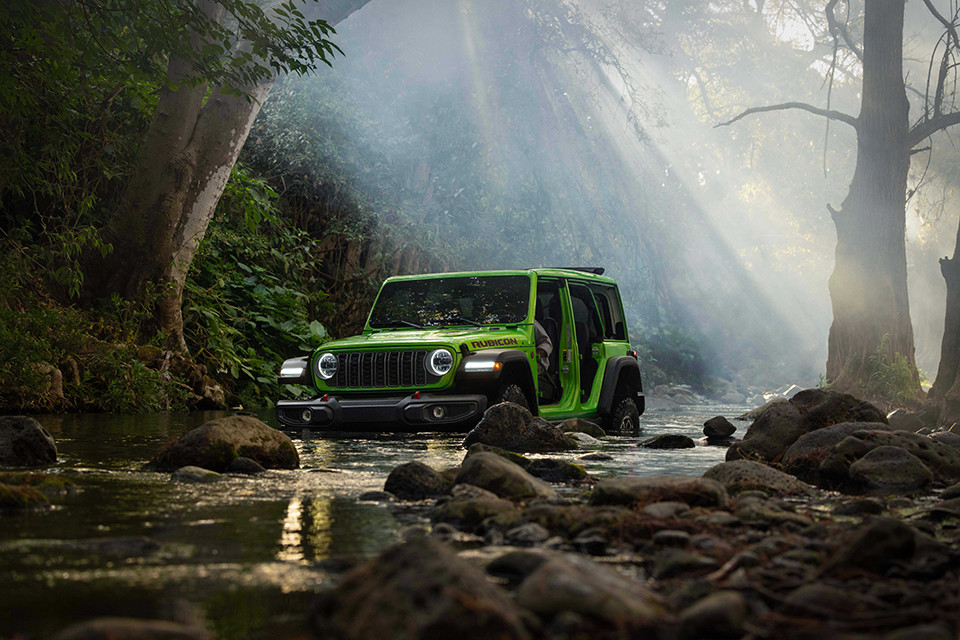
Interior, Cargo, and Technology
The 4Runner has a decisive advantage in interior practicality. Available three-row seating (for up to seven passengers), cargo volume that is nearly three times the Wrangler's seats-folded figure, and a larger infotainment screen on higher trims make the 4Runner a more capable family hauler. The Wrangler's removable body components — doors, roof, fold-down windshield — give it an open-air experience that no other mainstream SUV can replicate. These are not equivalent trade-offs; they reflect genuinely different vehicle philosophies.
| Feature | 2026 Jeep Wrangler (4-door) | 2026 Toyota 4Runner |
|---|---|---|
| Seating Capacity | 5 | 5 (7 with available 3rd row) |
| Cargo (2nd row folded) | ~872 L | ~1,128 L |
| Cargo (all seats folded) | ~872 L | ~2,540 L |
| Infotainment Screen | Uconnect 5, 12.3" | 14" touchscreen |
| Apple CarPlay / Android Auto | Wireless | Wireless |
| Heated Front Seats | Available (Sahara+) | Standard (higher trims) |
| Heated Steering Wheel | Available (Sahara+) | Standard (higher trims) |
| Digital Driver Cluster | Available | Available |
| Head-Up Display | Available | Available (Limited+) |
| Toyota Safety Sense / FCW + AEB | FCW + AEB standard | Toyota Safety Sense 3.0 standard |
| Removable Doors | Yes | No |
| Removable Roof | Yes (soft top, hard top, Sky One-Touch) | No |
| Fold-Down Windshield | Yes | No |
| Hybrid Battery Warranty | 8 yr / 160,000 km (4xe) | 8 yr / 160,000 km (i-FORCE MAX) |
For Alberta families loading hockey gear, camping equipment, and dogs into the back, the 4Runner's cargo advantage is practical and immediately noticeable. For buyers who want the windows out, doors off, and top stowed on a July long weekend in the Rockies, the 4Runner simply cannot compete with what the Wrangler offers.
Towing Capacity: A Clear 4Runner Advantage
The 4Runner carries significantly more than the Wrangler when it comes to towing — a point that often decides this comparison for buyers who regularly pull a trailer.
| Vehicle | Engine | Towing Capacity | What That Moves in Alberta |
|---|---|---|---|
| 2026 Jeep Wrangler (4-door) | 3.6L V6 / 2.0L Turbo / EcoDiesel | 1,587 kg (3,500 lbs) | Jet ski, single ATV, small utility trailer |
| 2026 Toyota 4Runner | 2.4L Turbo / i-FORCE MAX Hybrid | 2,268 kg (5,000 lbs) | Mid-size boat, dual ATV trailer, small camper |
The 681 kg (1,500 lbs) gap between these ratings is the difference between a capable and an insufficient tow vehicle for many Alberta use cases. A mid-size fishing boat on a trailer commonly weighs 1,600–2,000 kg fully loaded. A dual ATV trailer with two sleds approaches 1,800 kg. A small travel trailer starts at around 1,400 kg. For drivers who pull any of those regularly — to Sylvan Lake, Pine Lake, or the foothills — the 4Runner's tow rating provides the margin the Wrangler cannot.
If towing is a secondary or occasional need (light utility trailers, kayak trailers, single-ATV loads), the Wrangler's 1,587 kg rating is adequate. If it's a primary consideration, the 4Runner is the better choice in this comparison.
2026 Jeep Wrangler vs Toyota 4Runner Price in Canada
The Wrangler's entry price is lower, and its highest-capability trim (Rubicon) is priced well below the 4Runner TRD Pro. Both vehicles offer a wide spread across trims.
2026 Jeep Wrangler — Approximate Canadian Pricing
| Trim | Starting Price (CAD) | Highlights |
|---|---|---|
| Wrangler Sport | ~$46,395 | 3.6L V6, Command-Trac 4WD, Trail Rated, steel bumpers |
| Wrangler Sport S | ~$49,395 | Upgraded tech, convenience features, Uconnect 5 |
| Wrangler Sahara | ~$58,395 | Selec-Trac full-time 4WD, body colour fenders, premium interior |
| Wrangler Rubicon | ~$64,395 | Rock-Trac 4:1, locking diffs front + rear, Dana 44 AdvanTEK axles, Rock mode |
| Wrangler 4xe (Sahara / Rubicon) | ~$67,000+ | PHEV, 375 hp combined, ~3.8 Le/100 km, federal EV incentives may apply |
2026 Toyota 4Runner — Approximate Canadian Pricing
| Trim | Starting Price (CAD) | Highlights |
|---|---|---|
| 4Runner SR5 | ~$49,990 | 2.4L Turbo, part-time 4WD, Toyota Safety Sense 3.0 |
| 4Runner TRD Off-Road | ~$54,990 | Multi-Terrain Select, Crawl Control, Bilstein shocks, available rear locker |
| 4Runner Limited | ~$60,990 | i-FORCE MAX hybrid available, premium interior, full driver assistance |
| 4Runner TRD Pro | ~$72,990 | i-FORCE MAX standard, KDSS, Fox shocks, rear locker, GX-style off-road hardware |
Prices are approximate MSRP in CAD before taxes, freight, and dealer fees. Contact Red Deer Dodge at 403-346-2035 for current 2026 Wrangler pricing, available Jeep Canada incentives, and in-stock inventory details. 4Runner pricing is available at Toyota dealers.
Which Is Better for Alberta Drivers?
Alberta's roads and seasons make this comparison particularly pointed. From October through March, virtually every road in Central Alberta is either snow-covered, ice-covered, or both. From April through June, spring runoff turns rural roads into obstacle courses. From July through September, gravel highways and forestry access roads west of Red Deer offer access to some of the best camping, fishing, and trail territory in western Canada. Both the Wrangler and the 4Runner handle all of that — but the balance of trade-offs lands differently depending on how you drive.
The 2026 Jeep Wrangler is the right choice if your priority is off-road trail performance, Trail Rated reliability regardless of which trim you choose, and the versatility of a removable top and doors. It is a better trail vehicle than the 4Runner at every trim level, and the Rubicon specifically operates in a different capability league from any 4Runner variant for technical terrain. The lower entry price and the breadth of engine options — including the EcoDiesel and 4xe — give buyers more ways to configure the vehicle for their specific use pattern. For solo or two-person Alberta drivers who spend meaningful time on trails, the Wrangler is the stronger pick.
The 2026 Toyota 4Runner is the right choice if cargo space, towing capacity, and fuel economy are primary drivers. Families who need to seat seven, haul sporting equipment, and tow regularly will find the 4Runner more useful on a weekly basis. The i-FORCE MAX hybrid's fuel economy advantage is real and significant on Alberta's long highway corridors. TRD Pro buyers get a genuinely capable trail vehicle — just not one that operates at Wrangler Rubicon levels on technical terrain.
For drivers who want Jeep's full SUV range, our Jeep Grand Cherokee is also worth considering — it offers more interior volume and higher towing capacity than both the Wrangler and the 4Runner, with available Trail Rated Trailhawk capability and a more refined highway driving experience than the Wrangler. Our team at Red Deer Dodge can walk you through how all three compare for your specific use case.
FAQ
Is the 2026 Jeep Wrangler more capable off-road than the Toyota 4Runner?
Which has better fuel economy: the 2026 Jeep Wrangler or Toyota 4Runner?
Which is better for Alberta winters, the Wrangler or the 4Runner?
How does the 2026 Wrangler compare to the 4Runner for towing in Canada?
What is the price difference between the 2026 Jeep Wrangler and Toyota 4Runner in Canada?
Can the Jeep Wrangler go places the Toyota 4Runner can't?